Author: Rahul

  • Branding kit can defeat thieves

    Branding kit can defeat thieves

    I have been a security specialist for 30 years and there are definitely lessons from other industries that could benefit farmers. If a thief doesn’t like the look of your quad bike, or doesn’t believe they can make a quick buck from selling it, they are less likely to take it. Who steals a 2001 Datsun Sunny when it’s parked next to a 2013 Aston Martin?

    It is, therefore, worth thinking about how you can make your farming equipment less attractive to a would-be thief. Take steps that subconsciously shout: “That’s my quad bike, hands off.”

    Yes, you can buy complex vehicle immobilisers and high-tech satellite tracking devices, but this increases your capital expenditure and can only provide part of the solution.

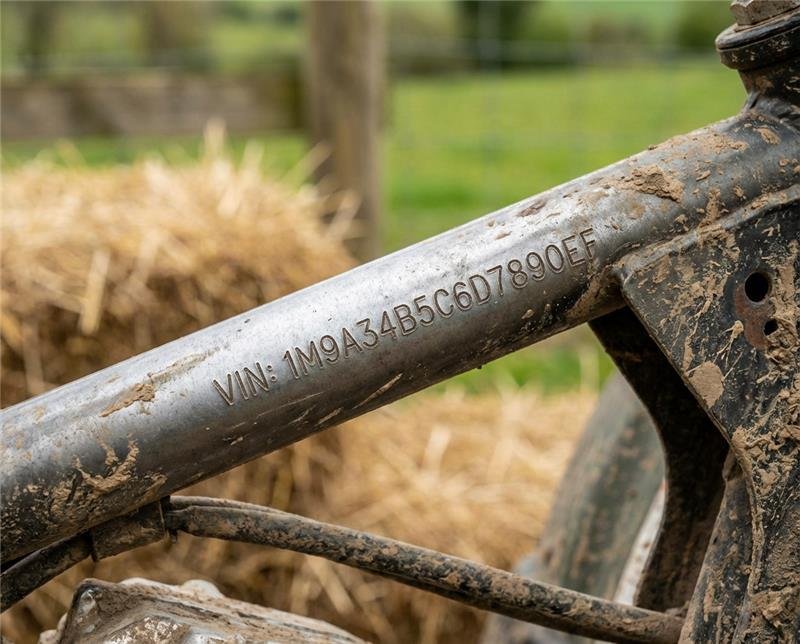
    In the first instance, I advocate low-cost, simple measures. You could engrave your postcode in prominent places, write your farm name or telephone number on exposed body panels or spot weld your favourite shape on the vehicle chassis. Essentially, create a visual mark that makes your property unique and quickly recognisable.

    As my granddad used to say, “In the good old days, we used to brand our horses so no one nicked them and, if they got caught, we’d hang ’em.” I’m not suggesting we bring back capital punishment for nicking a tractor, but there is something in the idea of “branding” your modern-day cart horse.

    You can go as far as marking your property with commercially available security marking solutions, which create a “forensic DNA” that enables identification of machines and authorised owners.

    If you will be looking to sell your machinery on after a few years then you need to be careful how you mark your property so as not to devalue it and prevent a sale. If, however, you buy it for lifetime use then be bold and consider customising it so it becomes one of a kind; unmistakably yours and something that would be considered out of place anywhere else.

    If you choose to customise or overtly mark your equipment, be sure not to alter the qualities of the commercially installed safety devices or negate the terms of your manufacturer’s warranty. Theft prevention strategies should also never introduce unacceptable risks to the health of you or those who operate the machinery.

    Additional vehicle marking advice can be found on the Construction Equipment Security and Registration scheme website and from the Plant & Agricultural National Intelligence Unit.

    If you choose to brand your equipment then take a digital photograph and add it to your equipment register. A picture paints a thousand words.

  • Complacency – A Farmer’s Worst Enemy In The Fight Against Rural Crime

    Complacency – A Farmer’s Worst Enemy In The Fight Against Rural Crime

    “Complacency” is an eleven letter word that scores 24 points in Scrabble. It could also be your worst enemy in the fight against rural crime.  

    Why? Because a complacent person believes that simple crime reduction measures are for other people and “equipment theft” is something they read about in Farmers Weekly between November and March when the dark nights are long and there may be fewer people around on the farm.  

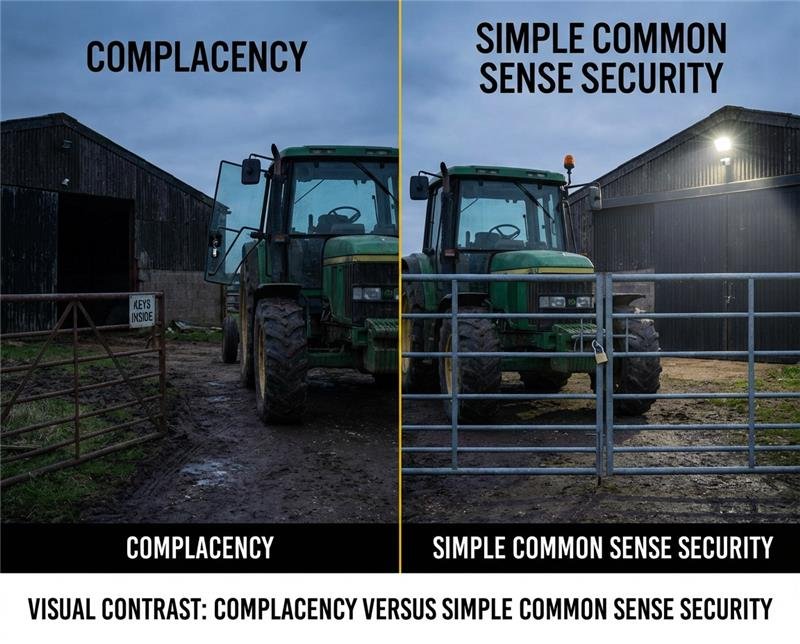
    But a series of simple, common-sense actions and behaviours can reduce the opportunity for a thief to succeed. 

    The sad fact is that it’s sometimes a lack of common sense that can increase your likelihood of becoming a victim of rural crime. It’s not uncommon to discover a £50k tractor left unattended overnight in an unsecure yard or barn.  

    However, removing the vehicle keys from the ignition, activating the engine immobilizer, locking the cab, closing and securing barn doors and closing and locking the yard gates would make the thief’s chances of stealing the tractor that much harder.  

    Will these simple security measures guarantee absolute protection? No, of course not, but they may deter the opportunist or cautious thief. 

    Speak to a commercial security adviser and they will most likely encourage you to spend thousands of pounds on strong fencing, robust gates, intruder detection and closed circuit television and – if a comprehensive security assessment concludes that’s proportionate and cost efficient – then they may be right. I would argue, however, that by creating a “security culture” in your own mind and those who work by adopting simple but effective counter-measures, you can deter, detect or delay a criminal long enough to initiate a suitable response.  

    The security industry often talks of the “Theft Triangle” consisting of three factors: motive, desire and opportunity. When all these factors are present, the likelihood of a theft is at its highest. You can seldom affect the motive or desire of a criminal, but you can reduce the opportunities for a willing and motivated thief. Remove the opportunity and the theft cannot occur. When assessing the probability of successfully removing your property, a thief must believe that the chances of getting caught are small or that the reward of success outweigh the consequences of failure. 

    Anecdotal evidence indicates that a significant proportion of rural crime – especially the theft of large agricultural machinery – is stolen to order and occurs only after prior reconnaissance or advanced surveillance. This means that the thief will have previously visited your farm or watched how and where you park your vehicles and equipment overnight. The thief will always have the initiative and can choose when to act.  

    So is it down to luck? No, it’s about doing the simple things habitually. It’s about creating a culture where everyone on the farm accepts the responsibility for protecting vehicles, equipment and tools.  

    It’s about thinking like a thief and identifying where the vulnerabilities lie. Ask yourself: “If I wanted to steal something from the farm, what would it be? How would I do it? Has the farmer done anything to prevent me from being successful?”  

    It’s about denying the opportunity for a thief getting to or removing those vehicles or pieces of equipment that you need to run your farm.  

    Consider what the thief will need to remove your property. If they need a vehicle to tow, lift or carry an item away, then focus on preventing them from getting close enough to the property they want to steal. Strategically set out your yard to create natural or engineered barriers; put heavy items of equipment or large tree trunks to deny a route of approach, dig ditches or create earth banks impassable by trucks or trailers, adapt and position obsolete property to block open areas or simply lock commercially engineered gates with high-quality shielded padlocks.  

    The more accessible your yard is to the public, the greater the chances of it being targeted. Consider where you park or store your most critical assets and always create a natural boundary between what is public space and your private property. Maximise the use of warning signage and learn how to recognise suspicious behaviour – and who to report it to.  

    Make your property unique by overtly marking it so it becomes easily recognisable; consider stamping your post code or a farm logo in places where it is obvious. Back this up with covert marking on numerous component parts, in case the stolen vehicle is disassembled for resale. Create an asset register to list all manufacturer’s serial numbers and record digital photographs of your most valuable or critical items of equipment.  

    Create a plan of what to do if you see something suspicious or you believe your property is subject to a criminal attack. Never place yourself in harm’s way and always collect as much information as possible to aid the police investigation; learn how to use your smartphone camera – it could help you collect critical evidence that leads to the recovery of your property.  

    In September 2015, the National Rural Crime Network (NRCN) stated that the true cost of rural crime in England and Wales could exceed £800m.  

    Farmers are busy and have many pressing tasks, but this alarming statistic highlights the need to never let complacency creep in.     Word Count: 906 

    *Frank Cannon is a security specialist with over 30 years’ experience in safeguarding people and property across the globe. 


    Published in Farmers Weekly, 1st February, 2016

  • Everyone must be a crimefighter

    Everyone must be a crimefighter

    Complacency” is an eleven-letter word that scores 24 points in Scrabble. It could also be your worst enemy in the fight against rural crime. A complacent person believes that simple crime reduction measures are for other people and equipment theft is something they read about in Farmers Weekly between November and March when the dark nights are long and there may be fewer people around on the farm.

    But a series of simple, common-sense actions can reduce the opportunity for a thief to succeed and of you becoming a victim of rural crime.

    It is not uncommon to discover a £50,000 tractor left unattended overnight in an unsecured yard or barn. However, removing the keys from the ignition, activating the engine immobiliser, locking the cab, closing and securing barn doors and closing and locking the yard gates would make a thief’s chances of stealing it that much harder.

    Will these simple security measures guarantee absolute protection? No, of course not, but they may deter the opportunist or cautious thief.

    A commercial security adviser might encourage you to spend thousands of pounds on strong fencing, robust gates, intruder detection and closed-circuit television, and there are instances when this does make sense. I would argue, however, that through the creation of a “security culture” in your own mind and across your employees, and by adopting simple but effective countermeasures, you can deter, detect or delay a criminal long enough to initiate a suitable response.

    The security industry often talks of the “Theft Triangle” consisting of motive, desire and opportunity. When all are present, the likelihood of a theft is at its highest. You can seldom affect the motive or desire of a criminal, but you can reduce the opportunities for a thief. Remove the opportunity and theft cannot occur.

    When assessing the probability of successfully removing your property, a thief must believe that the chances of getting caught are small or that the rewards of success outweigh the consequences of failure.

    Anecdotal evidence indicates that much rural theft, especially of large agricultural machinery, involves items stolen to order and occurs only after prior reconnaissance or advanced surveillance. This means that the thief will have previously visited your farm or watched how and where you park your kit overnight. The thief will have the initiative and can choose when to act.

    So is it down to luck? No, it’s about doing the simple things habitually. It is about creating a culture where everyone on the farm accepts responsibility for protecting vehicles, equipment and tools. It’s about thinking like a thief and identifying the vulnerabilities. Ask yourself: “If I wanted to steal something from the farm, what would it be? How would I do it? What obstacles might prevent me from being successful?”

    It is about denying the opportunity for a thief to get to or remove vehicles or pieces of equipment. If they need a vehicle to tow, lift or carry an item away, then focus on preventing them from getting close enough to the property they want to steal. Set out your yard to create natural or engineered barriers; put heavy items of equipment or large tree trunks to deny a route of approach, dig ditches or create earth banks impassable by trucks or trailers, adapt and position obsolete property to block open areas or simply lock commercially engineered gates with high-quality padlocks.

    The more accessible your yard is to the public, the greater the chances of it being targeted. Consider where you park or store your most critical assets and always create a natural boundary between what is public space and your private property. Maximise the use of warning signage and learn how to recognise suspicious behaviour and who to report it to.

    Make your property unique by overtly marking it so it becomes easily recognisable; consider stamping your postcode or a farm logo in places where it is obvious. Back this up with covert marking on numerous component parts. Create an asset register to list all manufacturers’ serial numbers and record digital photographs of your most valuable or critical items of equipment.

    Plan what to do if you see something suspicious or believe your property is subject to a criminal attack. Never place yourself in harm’s way and always collect as much information as possible and assist the police; learn how to use your smartphone camera. It could help you collect evidence that leads to the recovery of your property.

    Farmers are busy with many pressing tasks, but it is important to never let complacency creep in.

  • That’s My Quad Bike”: An Essential Guide To Reducing Farm Yard Equipment Theft  

    That’s My Quad Bike”: An Essential Guide To Reducing Farm Yard Equipment Theft  

    If the crook doesn’t like the look of your quad bike, or doesn’t believe he can make a quick buck from selling it on, he is less likely to take it in the first place. Who steals a 2001 Datsun Sunny when it’s parked next to a 2013 Aston Martin? Think how you can make your farming equipment less attractive to any would-be thief? Take positive steps that subconsciously shout-out, “that’s my quad bike- hands off!” 

    Yes, you can buy extremely complex vehicle immobilizers and high-tech satellite tracking devices (type ‘Thatcham security standards’ in your computer search engine to see how) to help prevent theft but this increases your capital expenditure and can only provide part of the solution. In the first instance, I advocate taking low cost and simple measures to dissuade people from helping themselves to your property. Measures like engraving your post code in prominent places, signwriting your farm name or telephone number on exposed body panels or simply spot welding your favourite shape on the vehicle chassis. Essentially, create a visual mark that makes your property unique and quickly recognizable.  

    As my grandad used to say, “In the good-old-days we used to brand our horses so no one nicked them and, if they got caught, we’d hang-em!” Well, I’m not suggesting we bring back capital punishment for nicking a tractor but I do believe there is something in the idea of ‘branding’ your modern day cart horse. You can go as far as marking your property with commercially available security marking solutions like Datadots® which is polyester micro-dots the size of a grain of sand with unique laser etched information such as a registration number or farm name. This creates a forensic DNA that enables identify the machines and the authorised owner.  

    The question you need to ask yourself is, ‘what do I want from my farming equipment?’ If you see yourself as a temporary custodian and will be looking to sell it on after a few years then you need to be careful how you mark your property so as not to devalue it and prevent a sale. If however, you buy it for life-time use then be bold and consider customizing it so it become one of a kind; unmistakably your and something that would be considered out of place anywhere else.     

    If you choose to customise or overtly mark your equipment, be sure not to alter the qualities of the commercially installed safety devices or negate the terms of your manufacturer’s warranty. Theft prevention strategies should never introduce unacceptable risks to the health of you or those who operate the machinery. Additional vehicle marking advice can be found on the Construction Equipment Security And Registration (CESAR) scheme website and from the Plant & Agricultural National Intelligence Unit (PANIU). To help you to actively protect your vehicles and to limit the effects of theft on your business, the NFU Mutual offer generous security discounts when an approved security device is fitted to your agricultural vehicles. 

    Finally, my overwhelming message is to do something that deters the thief from removing your property to make a quick buck. If you choose to brand your equipment then take a digital photograph and add it to your equipment register – a picture paints a thousand words.  

    *Frank Cannon is a security specialist with over 30 years’ experience in safeguarding people and property across the globe.

    Published in Farmers Weekly, 1st February, 2016

  • Private Sector’s Response to Rural Crime

    Private Sector’s Response to Rural Crime

    As NFU Mutual’s newly released Rural Crime Report 2025 receives widespread attention, it serves as a reminder that while some reductions in insurance claims have been seen, rural communities continue to face significant challenges. The insurance provider estimates that combined claims costs due to rural crime across 2023 and 2024 reached approximately £96.9 million.

    It is in response to this challenge that Rural SafeGuard™ has been established. Developed by a leading risk management consultancy and member of the National Rural Crime Network, Optimal Risk Group, Rural SafeGuard™ aims to support rural security and resilience.

    “The countryside has often been overlooked when it comes to coordinated security planning,” says Frank Cannon, Programme Director. “Through Rural SafeGuard™, we hope to provide rural residents with practical and proportionate ways to reduce opportunities for crime.”

    Created specifically for the farmers, the programme aims to:

    • Equip farmers with skills, knowledge and training needed to safeguard their people, property, and livestock from organised and opportunist crime.

    • Be a trusted source of information to demystify the journey to create secure and low crime agricultural businesses whilst helping all to speak a common language around crime reduction initiatives.

    • Work to improve farm defences and influence behaviours to increase resilience whilst reducing post-incident recovery time.

    • Encourage new entrants in the farming and agricultural industry to nurture an entrepreneurial mindset to support our aims.

    With all the recent surveys suggesting farmers continue to suffer from crime, and the fear of crime, this programme draws on proven security solutions used to protect other UK commercial sectors including retail, construction, transport, corporate, event management, and many more.

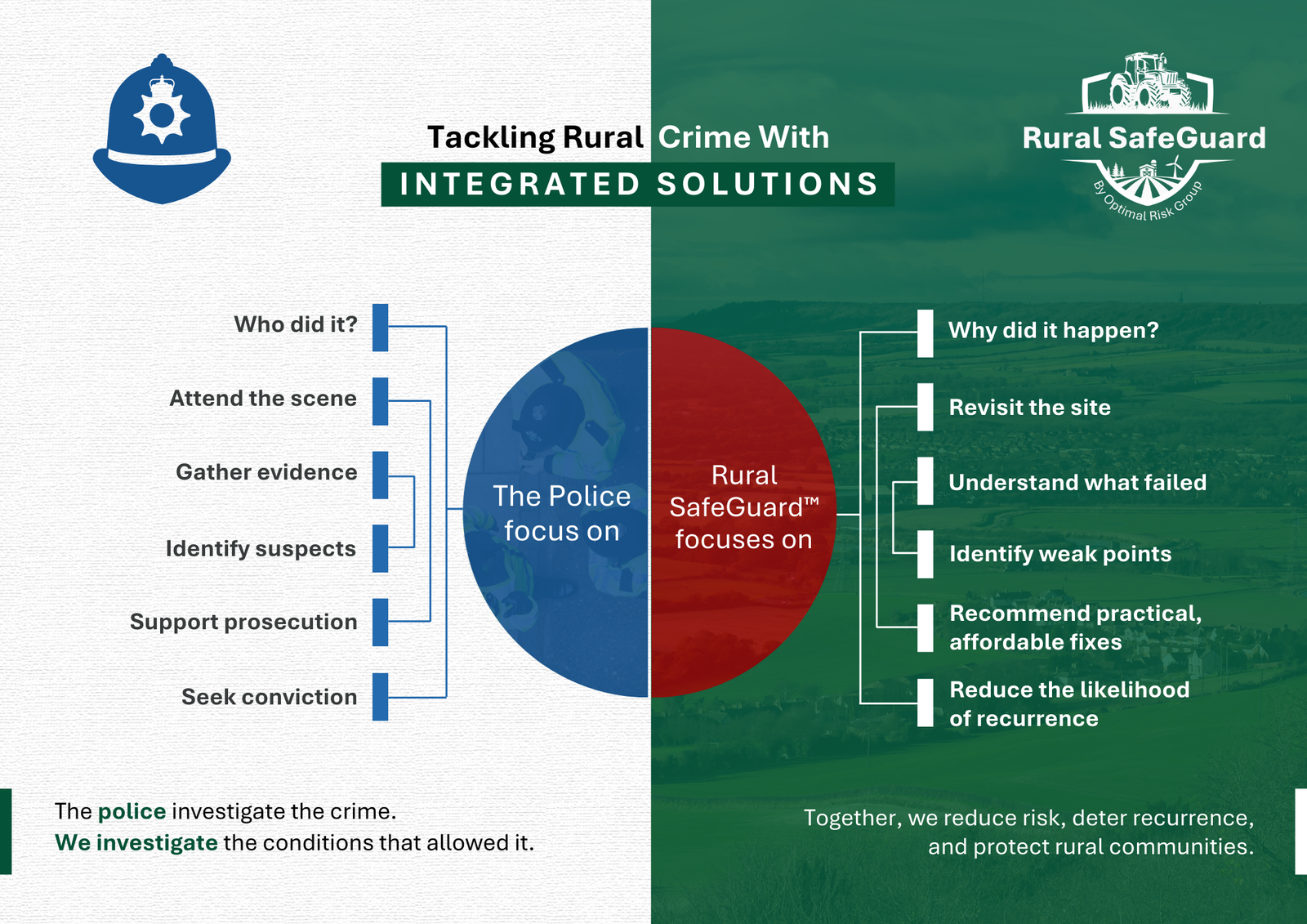
    Rural SafeGuard™ is a leading example of how private security can work together with the police to help progressive British farmers develop a culture to withstand crime across our countryside.

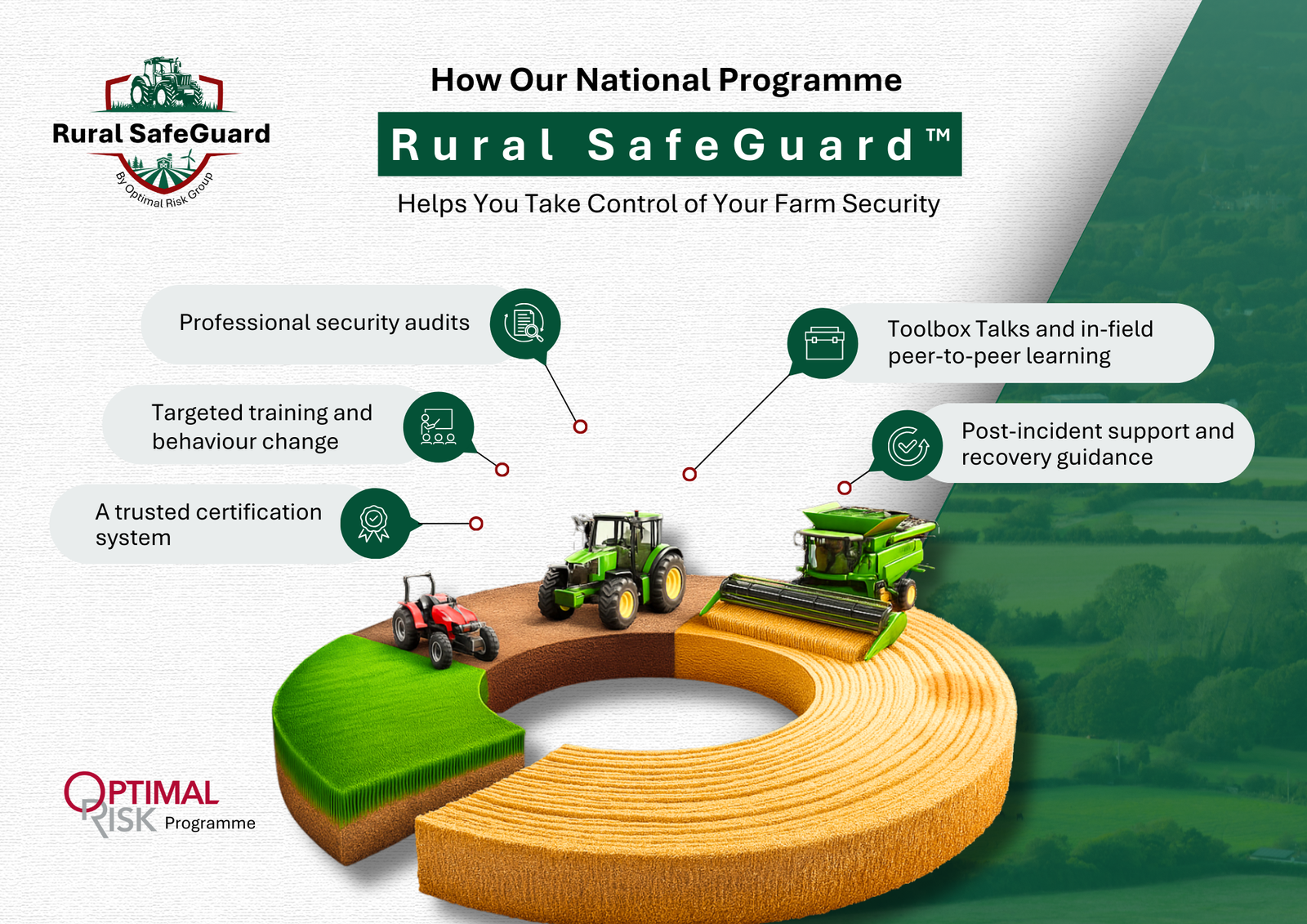
    Through security audits, training, recognition certifications for secure rural properties, and post-incident support, the programme is looking to build national rural resilience.

    The Rural SafeGuard™ team is already active in the field, conducting proof-of-concept audits and gathering insight from farmers, insurers, and estate managers. The team is seeking direct conversations with farmers, landowners, and like-minded agricultural service providers to integrate findings and further improve the programme.

    “This is about more than crime reduction,” says Cannon. “It’s about securing Britain’s food supply.”

    If you think this might be of interest to you, as a farmer or as a potential partner, reach out to Frank Cannon at frank.cannon@optimalrisk.com.

  • How do you protect a remote farm or rural business against rural crime when it is set in an isolated location within the UK countryside?

    How do you protect a remote farm or rural business against rural crime when it is set in an isolated location within the UK countryside?

    Protecting isolated farms in the UK countryside is crucial due to the escalating threat of rural crime, which encompasses both opportunistic theft and activities by organised crime groups. These crimes not only inflict significant financial losses but also jeopardise the safety and well-being of farming communities.

    Why isolated farms are vulnerable

    The remote nature of rural farms makes them attractive targets for criminals. Limited surveillance, sparse population, and delayed police response times contribute to their susceptibility. According to the Country Land and Business Association (CLA), there are at least 22 serious organised criminal gangs operating in the UK countryside, engaging in activities such as machinery theft, illegal hare coursing, and waste dumping .BBC News, NFU

    Types of crimes affecting rural farms

    • Machinery and equipment theft: High-value items like tractors and GPS systems are frequently stolen. For instance, a farmer in Hertfordshire reported the theft of GPS components worth £20,000 each from multiple tractors in a single night, severely disrupting farm operations. BBC News
    • Livestock rustling: Organised gangs have been involved in large-scale livestock thefts. In one case, 300 sheep valued at £35,000 were stolen during a farmer’s father’s funeral, highlighting the calculated nature of such crimes. The Times
    • Fly-tipping and illegal waste disposal: Criminals often dump hazardous waste on farmland, causing environmental damage and financial burdens for farmers who must pay the cleanup costs. NFU
    • Food and commodity theft: Small food producers and farm shops have become targets for organised crime, with thieves posing as legitimate buyers to steal large quantities of goods, such as cheese and smoked salmon. The Guardian
    • Hare coursing and wildlife crime:  In January 2025, about 25 speeding cars, reportedly driven by men in balaclavas, swept through Cambridgeshire farmland, leaving a trail of chaos and destruction behind them. They were allegedly there to engage in hare coursing. BBC News

    Impact on farmers and communities

    The consequences of rural crime extend beyond financial loss. Farmers experience psychological stress and a constant sense of vulnerability. Simon Porter, a farmer from Hampshire, described his situation as “constant warfare” against thieves and illegal gangs, leading him to invest £10,000 in farm defences like concrete barriers. BBC News

    Moreover, the lack of adequate police resources in rural areas exacerbates the problem. Many farmers feel that law enforcement is ill-equipped to handle the unique challenges of rural crime, leading to underreporting and a sense of isolation.

    Therefore, the protection of isolated farms is essential to combat the increasing incidence of rural crime, which poses significant risks to the agricultural sector and rural communities. Implementing comprehensive security measures and enhancing law enforcement capabilities are vital steps toward ensuring the safety and sustainability of the UK’s countryside.

    When farmers engage in reducing rural crime it is not only beneficial for their individual businesses but also crucial for the well-being of the broader community and the preservation of the rural way of life.

    Benefits of a farm self-assessment

    Focusing on security best practices serves as a proactive tool for farmers to evaluate and enhance the protective-security measures on their properties. By systematically reviewing current protocols, farmers can identify vulnerabilities, create and implement improvement plans, and increase business resilience aligned with industry standards.

    Key purposes of a farm security self-assessment

    • Identify vulnerabilities: Assessing existing security measures helps in pinpointing weak spots, such as inadequate lighting, lack of surveillance, or unsecured access points, which could be exploited by opportunistic thieves or organised crime groups.
    • Enhance security measures: By recognising deficiencies, farmers can take corrective actions like installing video surveillance systems, marking and securing equipment, installing technical tracking devices, and improving perimeter defenses to deter criminal activities.
    • Promote continuous improvement: Regular self-assessments encourage ongoing evaluation and refinement of security practices, ensuring that measures evolve in response to emerging threats, changing attack methodologies, and post-incident learnings.
    • Support compliance and assurance: Engaging in self-assessment aligns with broader agricultural standards and sustainability frameworks, demonstrating a commitment to responsible farm management.
    • Empower farmers: The process fosters a sense of ownership and control over farm security, enabling farmers to make informed decisions and reduce reliance on county police forces.

    In summary, conducting a farm security self-assessment is a strategic approach to safeguarding agricultural assets, ensuring compliance, and fostering a behavioural-based security culture that encourages continuous improvement in farm management practices.